You took a tree out. What goes back?
Robinson Tree Service · Memphis, TN
Where to put it, how big it will actually get, and which trees are worth planting in Memphis soil — including an honest look at the free tree the power company will give you.
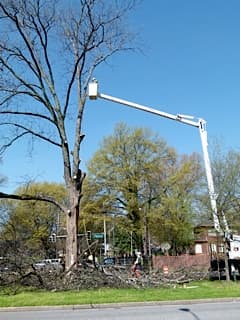
A removal leaves a gap, and the gap is usually the first thing anyone mentions afterwards. It looks bare. The sun comes in at a different angle. The question that follows is nearly always the same one: what do we put back, and can it go where the old one was?
The short answer to the second half is: probably not in exactly that spot, and probably not the same tree. Here is how to think about it.
Not in the same hole
If the stump was ground, the hole left behind is full of wood chips, not soil. Chips are not a growing medium. As they break down they pull nitrogen out of the ground around them, and they settle, so a tree planted on top of them sinks over the first couple of years and ends up too deep. Too deep is the most common way a young tree dies slowly.
The old root system is still down there too, spreading out well past where the trunk was, and it will be in the way for years. You cannot see any of this from the surface, which is why people plant straight into it.
- Easiest fix: move over. Six to ten feet to one side puts the new tree in undisturbed soil and costs you nothing.
- If it has to be the same spot, dig the grindings out properly, back-fill with topsoil, and give it a season to settle before planting.
- Do not pile the grindings up and plant into the mound. It looks right the day you do it and it is wrong within two years.
- Loosen the ground wider than you think. Roots spread out, not down — a wide shallow hole beats a deep narrow one every time.
Decide the size first. Species comes second.
The most expensive mistake in a yard is buying a tree for the pot it is in rather than the forty years in front of it. A willow oak and a redbud are the same thing on the nursery lot. One of them ends up seventy feet over your roof.
So work backwards. Look at where it is going, work out what mature size that spot can carry, and only then pick from the trees that fit.
- LARGE, 50 ft and up — willow oak, Nuttall oak, Shumard oak, bald cypress, blackgum. These are the trees worth having in a Memphis yard, and they need 30 to 40 feet from the house and real room overhead. An open back yard, not a side strip.
- MEDIUM, 30-45 ft — American hornbeam, Chinese pistache, trident maple. About 20 feet out. These are what most front yards can honestly take.
- SMALL and ORNAMENTAL, under 25 ft — eastern redbud, flowering dogwood, serviceberry, fringe tree, crape myrtle, Japanese maple, yaupon or Foster holly. Ten to fifteen feet is fine. These are also the only ones that belong anywhere near a power line.
Two things that are not on that drawing and catch people out: a septic field, which large roots will find, and the property line. A tree planted three feet from the line is a conversation with the neighbor in fifteen years, every time.
The power line decides it for you
MLGW says roughly 40% of its power outages are caused by trees, and its contractors work a three-year trimming cycle across Shelby County. If you plant something that reaches fifty feet under a distribution line, you are not planting a tree so much as scheduling its mutilation — it will be cut back into a shape nobody wants, repeatedly, for the rest of its life.
Under or within about twenty feet of an overhead line, nothing with a mature height over about 25 feet. That is the whole rule.
About MLGW's free tree
This part is worth knowing because almost nobody does. Through a program called Trade-A-Tree, MLGW will replace a tree it removed with a low-growing one, free. Your choice of a Bradford pear or a crape myrtle, or shrubbery — Foster holly, photinia, weeping privet or Japanese maple.
The thinking behind it is sound: keep the mature height down and the line stays clear. The list itself has not aged well, and two of the six are ones we would steer you away from.
- Crape myrtle — take it. Heat and drought tolerant, right size, flowers all summer, and it genuinely belongs in a Memphis yard. This is the pick.
- Japanese maple — fine, and lovely, but give it afternoon shade here or it scorches.
- Foster holly — fine. Evergreen, tidy, good if you want a screen.
- Photinia — the red tip. It is extremely prone to Entomosporium leaf spot in a climate like ours, there are no resistant varieties, and Arkansas's extension service has taken it off its recommended list outright. You will be looking at spotted, dropping leaves most springs.
- Bradford pear — no. The Tennessee Invasive Plant Council lists Callery pear as an established invasive threat in this state. Set that aside and it is still a tree built to come apart: narrow branch unions, the whole crown splitting out of the trunk in a storm. We are called out to them.
- Weeping privet — ask which species before you accept it. Chinese privet is on the same Tennessee invasive list, as an established threat.
None of that means turn the program down. It is a free tree and the height logic is right. It means ask for the crape myrtle, and say no to the pear.
What actually does well here
Memphis moved from zone 7b to zone 8a when the USDA redrew its hardiness map in 2023 — about three degrees warmer at the cold end. Practically, that widens what will survive a winter here, but it does not change the thing that actually kills trees in this city, which is August. Heat, humidity, heavy clay under the loess, and a dry late summer like the one we just had.
Trees that handle that are the ones to plant. The oaks in the list above are not there for decoration: willow oak and Nuttall oak in particular take Memphis conditions, including ground that stays wet after a storm and then bakes. Bald cypress will grow in a wet corner where nothing else will and is perfectly happy in a dry one. Blackgum gives you the best fall color of anything on the list.
For a small tree, redbud and serviceberry both flower before anything else wakes up, and fringe tree is the one nobody plants and everybody asks about afterwards.
What not to plant, whatever the nursery says
The Tennessee Invasive Plant Council lists four trees as established invasive threats in this state. None of them should go in a yard:
- Bradford or Callery pear (Pyrus calleryana)
- Mimosa, also sold as silktree (Albizia julibrissin)
- Tree of heaven (Ailanthus altissima)
- Empress or princess tree (Paulownia tomentosa)
Three more are on the same list as emerging threats — chinaberry, Chinese tallowtree and the Chinese parasol tree. And one that is on no list at all but we would still talk you out of: silver maple. It grows fast, which is the only argument for it, and it is weak-wooded, surface-rooted and over your driveway in twenty years. A lot of our removals are silver maples.
When to plant, and the one thing to get right
Fall is the right window in Memphis — roughly October into December. The ground is still warm enough for roots to move, the top of the tree is shutting down for the year so nothing is competing for water, and the tree gets a whole winter and spring to settle in before its first real summer. Spring planting works; it just means the tree faces August with three months of root growth instead of nine.
And the one thing that matters more than species, more than timing, more than anything you will buy at the nursery: plant it at the right depth. The flare at the base of the trunk, where it widens out into the roots, should be at or slightly above the surface of the ground. If you cannot see a flare, the tree is too deep in its own pot and you need to pull soil off the top until you find it.
- Dig the hole two to three times as wide as the root ball and no deeper than the ball itself.
- Find the root flare before you decide how deep the hole is.
- Cut off anything circling the root ball. Roots that spiral keep spiraling and eventually strangle the trunk.
- Backfill with the soil that came out. Do not improve it — a pocket of good soil in heavy clay just keeps the roots in the pocket.
- Mulch two to three inches deep, out as wide as you can stand, and keep it off the trunk. Never a volcano of mulch piled against the bark.
- Water it deeply through the first two summers. A newly planted tree has no root system yet, and Memphis will find that out for you.
If you are not sure what the spot will carry, or what the old root system has left you to work with, that is worth half an hour of a certified arborist's time before you spend money at a nursery. Our estimates are free, and we will tell you plainly if the answer is that nothing large should go back there.
Where these numbers come from
- Tennessee Invasive Plant Council — Tennessee invasive plant list (Callery pear and Chinese privet, both established threats)
- MLGW — Tree Trimming, Trade-A-Tree replacement program and line clearance policy
- Memphis Area Master Gardeners — Memphis moved from zone 7b to 8a on the 2023 USDA map
- USDA Plant Hardiness Zone Map — look up your own ZIP code
- University of Arkansas Plant Health Clinic — photinia dropped from the recommended landscape list over Entomosporium leaf spot
- International Society of Arboriculture — planting a tree, including planting depth
If this is your situation
Questions about a tree on your property? 901-363-3539, or send us a note. Estimates and preventative check-ups are free.
More from us
Or email us for a free preventative check-up for your trees.
Fill out the form and tell us what kind of tree service is needed: from tree removal, trimming, to firewood or just a health check. We have a certified arborist and professional crews who know the trees of Memphis.